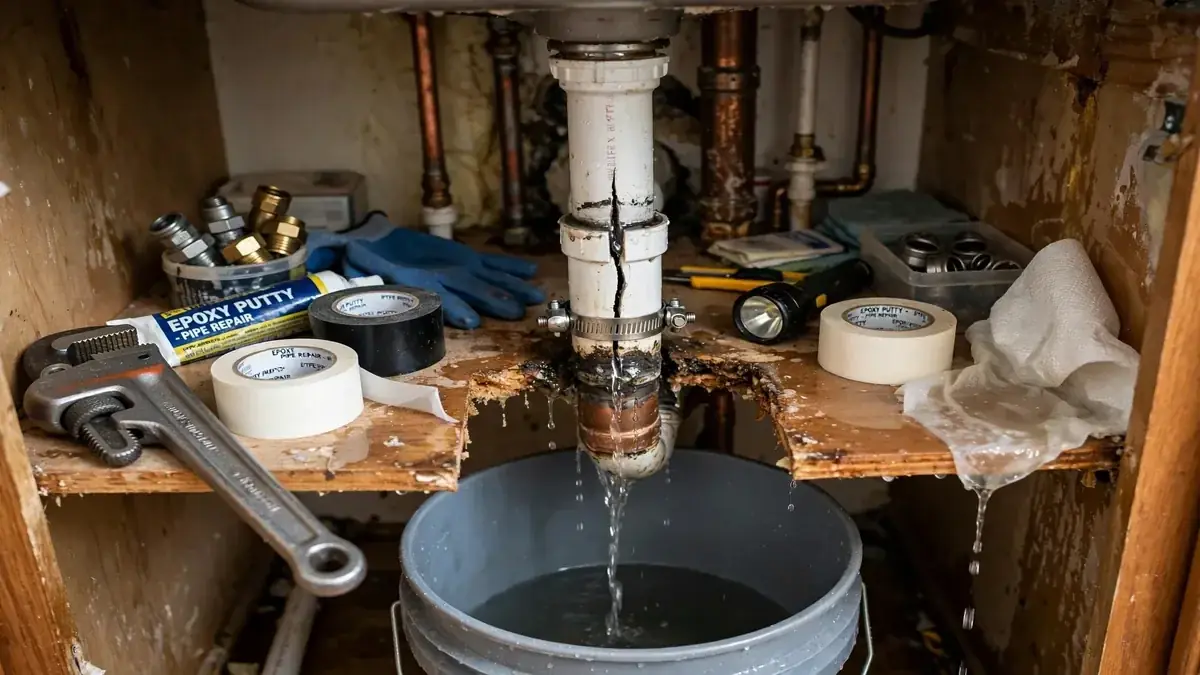
Walk into a hardware store and the tape aisle has at least four products that look similar. White tape for threads, yellow tape for gas, silicone self-fusing tape for emergency wraps and metal-backed repair tape for ducts. They are not interchangeable, and using the wrong one can create a leak instead of curing one.
This guide explains what each does and where it belongs. It also covers the limits of a tape repair. A wrap around a pinhole leak buys time, but it is not a permanent fix, and some leaks should not be taped at all.
If water is spraying, shut off the main valve first. Tape works on a dry pipe.
PTFE thread seal tape
This is the thin white tape sold as plumber's tape or Teflon tape. It goes on male pipe threads to fill the gap between threads so a threaded joint does not drip. Wrap it clockwise as you look at the end of the pipe, so it tightens into the thread rather than unwrapping. Three to four turns is typical.
It does not repair a cracked pipe, and it does not belong on compression fittings, flare fittings or the rubber washer seats on a hose connection. Those seal with the washer or the cone, not the threads.
| Tape | Use it for | Do not use it for |
|---|---|---|
| White PTFE tape | Water pipe threads | Compression and flare fittings, cracked pipes. |
| Yellow PTFE tape | Gas pipe threads (check the label) | Water joints where white is specified. |
| Silicone self-fusing tape | Temporary wrap on a small pipe leak | Permanent repair, hot gas flues. |
| Epoxy putty stick | Small cracks on dry metal pipe, temporary | Pressurized spraying leaks. |
| Pipe thread compound | Threads, alone or with tape | Fittings that seal on a washer. |
Self-fusing silicone tape for emergencies
Silicone tape stretches and bonds to itself, forming a rubbery wrap. Wrap tight with overlap along the pipe past both sides of the leak. It can hold a pinhole or a loose joint for a short time until the pipe is replaced.
Treat it as a bridge to a repair. Pressure and time will find the weak spot again, and a hidden pipe that has begun to leak has often corroded elsewhere.
When tape is the wrong answer
- Gas leaks, which need the gas company or a licensed gas fitter.
- Leaks on a water heater tank or its relief valve.
- A pipe that is corroded for a long stretch, not just at one hole.
- Any leak you cannot see, such as in a wall or under a floor.
If the leak is inside a wall, ask about leak detection. If a pipe has burst, see burst pipe repair.
A better temporary fix for a pipe leak
A rubber patch with a hose clamp is a more reliable emergency repair than tape on a copper or steel pipe, and the plumber can remove it later. Whichever you use, shut off water, dry the pipe and mark the date. The repair should be replaced soon.
After the patch, check the meter with everything off. A moving dial means there is still a leak somewhere.
How to apply thread tape step by step
Clean the threads
Wipe the male threads clean and dry. Old tape and debris prevent a seal.
Wrap clockwise
Hold the pipe end toward you and wrap clockwise, starting at the second thread.
Overlap and press
Overlap each turn by about half and press the tape into the grooves.
Assemble by hand
Thread the fitting on by hand, then tighten with a wrench without overdoing it.
Test
Turn on the water slowly and look for drips at the joint.
Tape or pipe dope
Pipe thread compound, often called pipe dope, is a paste applied to threads. Many plumbers use compound alone, tape alone or both. Paste fills gaps and is easier to work with on larger pipe. Tape is cleaner on small fittings. Use a product labeled for the pipe and the fluid you are sealing.
Replacing the fitting is often better
If a threaded joint leaks again after retaping, the threads may be damaged. Wrapping more tape hides the wear and invites a bigger leak later. A new fitting costs little and gives a clean start.
Likewise, a joint that has dripped for months leaves mineral crust and corrosion behind. Replace it, do not wrap it. If you are not sure which fitting you have, take a photo and call.
Quick reference for the hardware store
- Threads on a water pipe or fitting: white PTFE tape or thread compound.
- Threads on a gas fitting: tape or compound labeled for gas, and a licensed gas fitter.
- A small leak on a dry pipe you need to hold for a day: silicone self-fusing tape.
- A pinhole you plan to replace soon: rubber patch and hose clamp.
- A leak you cannot see: do not tape, call.
Write down the date and the location of any temporary repair, and tell your plumber about it when they visit.
Pipes in Santa Paula homes
Santa Paula has older neighborhoods around the downtown historic district, and houses of that age may have galvanized steel pipe that is rusted through at the threads. Tape on rusted threads does not hold well. Replacing the fitting or the section is the lasting answer.
Ask your water utility about the water pressure at your meter. High pressure stresses taped joints. A gauge on a hose bib gives you a reading, and our repiping page explains when tape is no longer worth it. We dispatch to Fillmore and Ventura as well.
Frequently asked questions
Clockwise as you look at the end of the pipe, so the tape tightens as you screw the fitting on.
Only temporarily and only silicone or similar repair tape. PTFE thread tape is not a pipe repair.
No. Gas joints use tape labeled for gas, usually yellow, or a compound rated for gas. Gas work should be done by a licensed professional.
Older homes near downtown may have corroded galvanized pipe where tape will not last. Replacing the section is better.
It varies. Treat it as a temporary fix and plan the real repair soon.
Tape is only a stopgap. Call our 24/7 line for the real repair.
Call (805) 249-7135