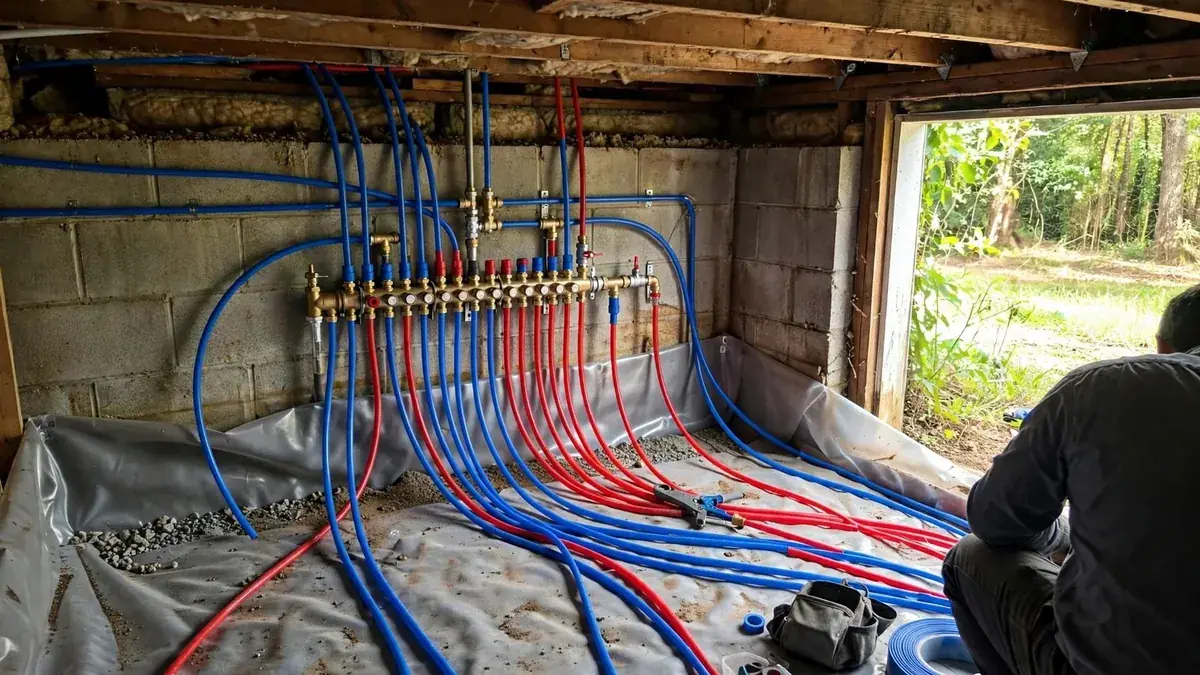
Repiping replaces the supply lines inside a house so hot and cold water reach every fixture through new pipe. In Santa Paula, CA, the call usually comes after repeated leaks, discolored water or pressure that has slowly faded.
A single repair is fine when one section has failed. When pipe is failing in several places, each repair buys a few months and the next leak shows up somewhere else. At that point, replacing the lines is often the calmer path.
Many of the homes in older parts of town were built long before modern pipe materials. If your house still has its original supply lines, a camera on the water side is not possible, but a pressure test and a look at accessible runs tell us a lot.
Signs the pipes are near the end
- Brown or yellow water when a faucet has not run for a while.
- Pressure that is weak at every fixture, not just one.
- Repeated pinhole leaks or green crust on copper joints.
- Visible rust and flaking on exposed steel pipe.
- Water stains on walls or ceilings with no single source.
One of these alone may have a simple fix. Two or three together point to a line that is wearing out. A plumber can look at what is exposed in the garage, crawlspace and under sinks and tell you what material you have.
Pipe materials we work with
| Material | Where it is found | Notes |
|---|---|---|
| Galvanized steel | Older homes | Rusts from the inside, restricts flow over time. |
| Copper | Many homes of all ages | Long lasting, can pinhole in some water. |
| PEX | Newer work and repipes | Flexible, fewer joints, quick to install. |
| CPVC | Some newer homes | Rigid plastic, can turn brittle with age. |
Which material fits your house depends on the walls, the water and your budget. We explain the options before any pipe is ordered, and permit rules vary, so ask the City of Santa Paula building department what applies.
Whole house or partial
A partial repipe replaces one branch, such as the line to a kitchen and bath that keeps leaking. A whole-house repipe replaces every supply line. We tell you which one makes sense after we see the layout and the condition of what remains.
What the work looks like
Walkthrough and plan
We trace the lines, note fixtures and agree on routing and access points.
Shut off and set up
Water is shut off and protection goes down in the work areas.
Replace the lines
New pipe is run to each fixture and connected to shutoffs and the main.
Pressure test
The system is tested under pressure before any wall is closed.
Restore and review
Water is turned back on, fixtures are checked and we walk you through the result.
Access holes in drywall are kept small and patched flat, but finish painting is a separate trade. We tell you where holes will be before we cut.
Water heater and fixtures at the same time
When the walls are open, it is a sensible time to replace old shutoff valves and tie in a new water heater. If a leak is hidden and you are not sure you need a repipe at all, start with leak detection. For an active burst, see burst pipe repair.
Repiping is regulated work under the California Plumbing Code, which local building departments enforce. Ask the City of Santa Paula how permits and inspections work for a whole-house repipe.
What affects repiping cost
We give you a clear price before work starts. The factors are:
More bathrooms and fixtures mean more pipe.
Copper, PEX and CPVC differ in material and labor.
Single-story crawlspace homes are simpler than slab or multi-story homes.
The number and size of access holes changes the finish work.
Ask the City of Santa Paula building department what your job needs.
Insurance often covers sudden damage but not wear and tear on old pipes, so a planned repipe is usually an out-of-pocket job. Want your real number? Call (805) 249-7135.
Repiping questions from Santa Paula homeowners
Repeated leaks, brown water and weak pressure at every fixture are common signs. A plumber can confirm after looking at the visible lines.
It depends on the size of the house and access. We give you a schedule when we give you the price.
Water is off during parts of the work. We plan the shutoffs so you are without water for as little time as possible.
PEX and copper are both common. We explain the tradeoffs for your house.
Often yes. Ask the City of Santa Paula building department what applies to your project.
Have a plumbing problem right now? Our line is answered 24/7.
Call (805) 249-7135