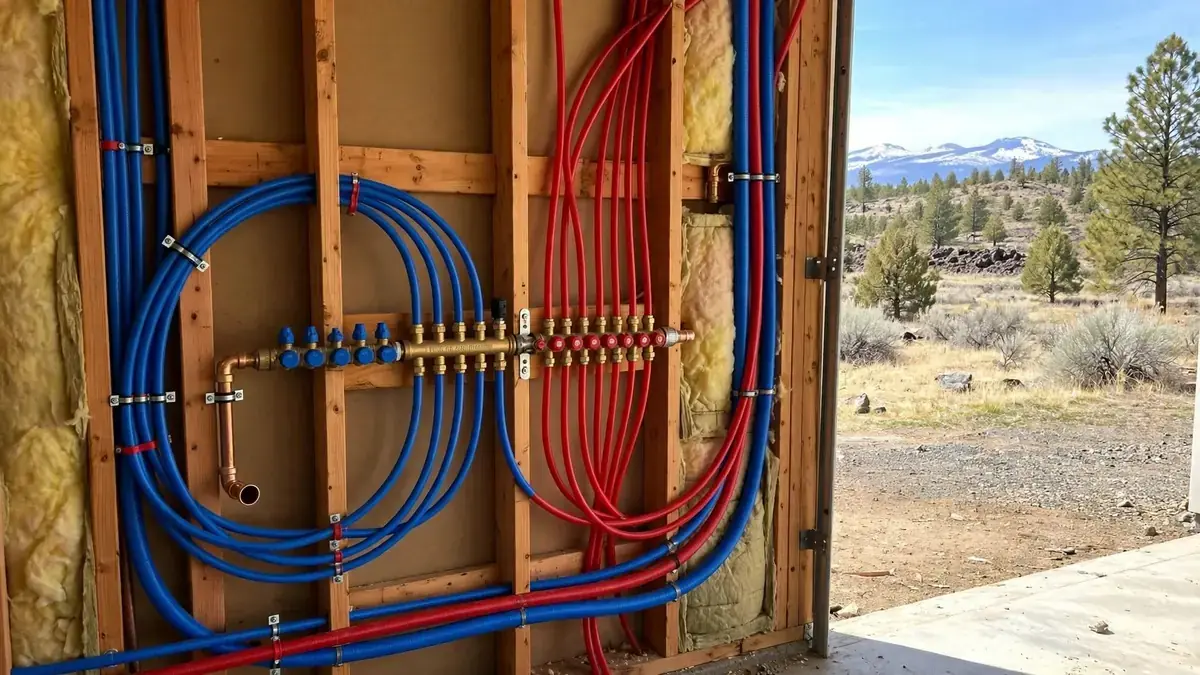
PEX is a flexible plastic pipe made of cross-linked polyethylene. It comes in coils, bends around corners and uses fewer joints than rigid pipe, which is why plumbers like it for remodels, additions and repipes. It does not corrode the way steel does and it does not pinhole the way thin copper sometimes can.
It is not the answer to every job. It breaks down in sunlight, it needs the right fittings and tools and some connections, like those at a water heater, have special rules. This guide covers how it works and what to ask before a plumber uses it in your house.
Rules about which pipe types are allowed vary, so ask the City of Santa Paula building department what applies to your project.
What PEX is and the common types
PEX is sold in colors, usually red for hot, blue for cold and white or gray for either. The names PEX-A, PEX-B and PEX-C describe how the pipe is made. They differ in flexibility and in how fittings attach, but all are used for household water supply.
| Pipe | Strengths | Watch for |
|---|---|---|
| PEX | Flexible, few joints, resists corrosion | Sunlight, rodents, special fittings. |
| Copper | Long lasting, rigid, handles heat | Corrosion in some water, higher material cost. |
| CPVC | Rigid plastic, easy to cut | Brittle with age in some cases. |
| Galvanized steel | Found in old homes | Rusts inside, restricts flow. |
How PEX connects
PEX joins with crimp rings, clamp rings or expansion fittings. Each method needs its own tool and the right fitting. A fitting that is not fully seated is a common leak point, so connections are inspected and pressure tested before the walls close.
Push-to-connect fittings are also used for repairs, especially in tight spots. They are convenient but should be chosen for places you can reach later.
Where PEX works well
- Whole-house or partial repipes, see repiping.
- Remodels, additions and accessory units, see plumbing installation.
- Runs through tight walls and attics where rigid pipe is hard to route.
- Homes where corroded steel or copper is failing.
Where to be careful
PEX should not sit in direct sunlight. Ultraviolet light degrades it, so exposed runs outdoors need protection or a different pipe. Keep it away from heat sources such as flues and recessed lights. Connections at a water heater usually use a short length of metal or a listed connector, so follow the heater maker's instructions.
Rodents can chew plastic pipe, so protect runs through open crawlspaces. And remember that a plastic pipe does not ground electrical systems the way old metal pipe sometimes did, so ask an electrician to check bonding if your old pipes are being replaced.
What to ask your plumber
- Which PEX type and fitting method will you use?
- How will runs be supported, protected and labeled?
- Will you pressure test before closing the walls?
- What does the permit or inspection involve?
When you are not sure whether your lines need replacing at all, start with leak detection or ask about the visible pipe in your garage.
Pressure testing and inspection
Before walls are closed, the new lines are pressurized and watched. A drop in pressure shows a leak that you can fix while the wall is open. Some jurisdictions require an inspection at that stage, so ask the City of Santa Paula building department.
Skipping the test saves minutes and risks a leak inside a finished wall, which is the most expensive place to find one.
Support, noise and water hammer
Flexible pipe needs support at regular intervals so it does not sag or rattle. Where it passes through framing, protective sleeves stop rubbing. Water hammer, the bang when a valve closes quickly, can be reduced with proper support and, where needed, arrestors.
What affects the cost and the timeline of a repipe
- The number of fixtures and the size of the house.
- How easily the walls and attic can be reached.
- Whether the water heater and valves are replaced at the same time.
- The amount of drywall repair needed afterward.
- Permit and inspection scheduling.
We explain these factors with a clear price before work starts.
PEX and your water heater
Most manufacturers do not want PEX connected straight to the top of a water heater, because heat and the connection can stress it. A short length of copper or a listed flexible connector is common. Follow the heater's installation instructions and the PEX maker's rules, and ask the plumber which they use.
Retrofitting PEX in an older home
In a house with plaster walls or finished ceilings, plumbers often fish PEX through small openings instead of tearing out walls. That is one reason it suits older houses. The work still creates holes at each fixture and at junction points, so plan for drywall repair and paint.
If the old pipe is galvanized steel, a full repipe usually gives better pressure than a patch. Partial runs of new pipe attached to rusted steel leave the flow limit in place.
PEX and Santa Paula homes
Many Santa Paula garages and crawlspaces have exposed pipe, and a garage with a window or an open door can let sun reach the pipe. Cover or sleeve any PEX that sees daylight.
Ask your water utility what pressure to expect at your meter, since high pressure is hard on any pipe. We also repipe homes in Fillmore and Ventura.
Frequently asked questions
PEX made for potable water is widely used in homes. Use fittings and pipe listed for drinking water.
It resists splitting better than rigid pipe, but it is not freeze proof. Insulate exposed runs.
Not in direct sun. Ultraviolet light weakens it, so protect or shield it.
Each has strengths. PEX is quicker to install and resists corrosion, copper handles heat and sun.
Exposed garage and crawlspace runs. Protect them from sun and animals.
Questions about pipe materials? Call us any hour.
Call (805) 249-7135