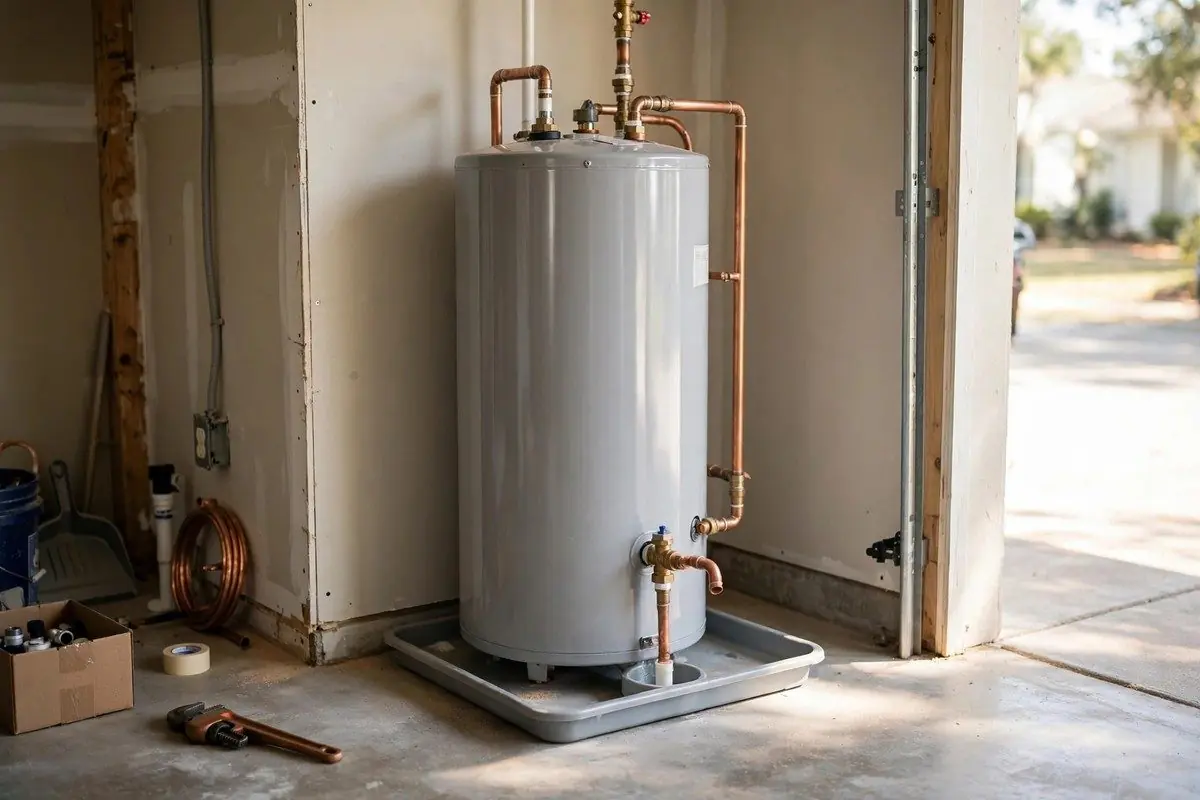
A water heater tank wears out from the inside. When the steel liner fails, the tank begins to weep or spill, usually onto a floor in a closet, a garage or a hallway. A drain pan sits under the tank and catches that water so it is easier to notice and does less harm.
A pan helps only when it is the right size and when its drain goes somewhere. A flat pan with no drain simply fills up and overflows, so the details matter. This guide explains what to look for before you buy one.
If your heater is already leaking, see our notes at the end about shutting it down.
What a pan does and does not do
A pan collects water from small leaks, condensation and drips at connections. It buys time and protects flooring. It does not stop a heavy failure, and it does not replace maintenance. A heater at the end of its life will still need replacing, see water heater replacement.
Some pans have an outlet for a drain pipe that leads to a safe place. Where a pan is installed above finished living space, a drain line or a leak alarm is especially useful.
| Feature | Why it matters |
|---|---|
| Diameter two inches wider than the tank | Catches water from the sides of the tank. |
| Side drain fitting | Lets water run to a safe place, not stay in the pan. |
| Material suited to the location | Plastic, aluminum or galvanized steel resist corrosion in different ways. |
| Raised lip | Contains water and keeps it from creeping onto the floor. |
| Room for the flue and pipes | The pan should not block access or venting. |
Sizing and drain requirements
Measure the tank diameter and add about two inches. A pan that is too tight will not catch water running down the side of the tank. If your heater is in a garage or on an upper floor, a drain pipe is especially valuable.
Drain and relief valve piping rules vary by jurisdiction, so ask the City of Santa Paula building department what applies to your installation. Do not connect a pan drain to the relief valve discharge pipe unless your plumber confirms it is allowed.
Installing the pan
Shut off and drain
Turn off the gas or power, close the cold supply and drain the tank. The tank must be light enough to move safely.
Set the pan
Slide the pan under the tank, centered, and check the drain fitting faces the right way.
Connect the drain
Run a pipe from the fitting to a safe location, sloping down.
Reconnect and test
Reconnect pipes, refill the tank, restore power or gas and check for leaks and proper venting.
Moving a tank is heavy and gas connections are hazardous. Most homeowners are better served by having this done at the same time as a replacement, see water heater installation.
If the heater is leaking right now
Turn off the power or the gas control, close the cold water valve at the top of the heater and open a hot faucet in the house to relieve pressure. If you smell gas, leave and call the gas company. Then call us.
Leak alarms and automatic shutoffs
A small battery alarm that sits in the pan sounds when water touches it. That is cheap insurance, because it tells you about a leak before you see it. Some systems also close the cold water valve automatically, which stops a failing tank from emptying onto the floor.
An alarm helps only if someone hears it. A heater in a garage far from the bedrooms may need a louder or smart alarm that sends an alert to your phone.
Warning signs the tank is failing
Signs to watch for
- Rust colored water from hot taps only.
- Water around the base of the tank.
- Rumbling or popping noises when the burner runs.
- A tank more than ten years old.
- Corrosion at the pipe connections on top.
Simple habits that help
Look at the floor around the heater every few months. Check the pan for water or debris and clear the drain. Follow your heater's instructions for flushing the tank and for testing the relief valve, since procedures differ by model.
Where the heater sits matters
A heater in a garage on a slab floods the garage, which may be bad but is rarely worse. A heater in a closet, a hallway or an upper floor can send water into living areas or through the ceiling below. The higher the risk, the more a drained pan and an alarm are worth.
Whatever your setup, a pan is a safety net. A healthy tank, a working relief valve and an eye on the floor are what keep a leak from happening.
Water heaters in Santa Paula homes
Many Santa Paula homes have heaters in garages, closets and utility rooms, and the closet or garage location is often just on the other side of a living space wall. A small leak that spreads along the floor can reach drywall before anyone sees it.
Ask your water utility about water quality at your tap. Test your tap for hardness, since scale shortens heater life, and see water softener and filtration if the test shows scale is a concern. Homeowners in Ojai and Ventura can call the same line.
Frequently asked questions
Not always, but it is smart where a leak could damage finished space. Ask the City of Santa Paula building department what applies.
About two inches wider than the tank diameter.
To a safe location, sloping down. Do not tie it into the relief valve line without a plumber's approval.
The pan is simple. Moving a full or gas-fired tank is not, so have it done with a replacement.
Garage and closet heaters are common here, so make sure the pan drain has a safe path outside or to a floor drain.
Heater leaking or near the end of its life? Call our 24/7 line.
Call (805) 249-7135