A puddle around a toilet can come from four different places, and each one has a different fix. The supply line, the tank bolts, the tank to bowl seal and the wax ring at the floor all leak in similar ways. Guessing wrong means replacing the wrong part and still having a wet floor.
This guide shows how Santa Paula homeowners can narrow it down in a few minutes with a roll of toilet paper, a dry towel and some food coloring. If the leak turns out to be at the floor, you will also know why it is worth calling a plumber before the subfloor suffers.
If water is actively pouring and will not stop, close the valve on the wall behind the toilet by turning it clockwise and skip to the last section.
Dry everything and watch where the water appears
Wipe the toilet, the supply line, the shutoff valve and the floor until everything is dry. Then lay strips of toilet paper on the floor around the base and under the supply connection. Paper shows a drip within minutes and tells you which side of the toilet is wet.
Flush once and watch. Water that shows only after a flush points to the base or the tank bolts. Water that appears while the toilet sits unused points to the supply line or the shutoff valve.
| Where the water shows | Likely cause | Typical fix |
|---|---|---|
| Wall valve or the braided line | Loose nut or worn washer | Tighten, replace the line or the valve. |
| Under the tank, drips on the bowl | Worn tank bolt washers | Replace bolts and rubber washers. |
| Between tank and bowl | Failed tank to bowl gasket | Replace the gasket. |
| Around the base, after flushing | Failed wax ring or loose flange | Pull the toilet and reset. |
| Sweating on the outside of the tank | Condensation | Insulated liner or a mixing valve. |
Test the tank with food coloring
Put a few drops of food coloring in the tank and wait fifteen minutes without flushing. If color shows up in the bowl, the flapper is leaking into the bowl. That is a running toilet problem, not a floor leak, and it can add to your water bill without any visible puddle. Our toilet repair page covers flappers and fill valves.
If the tank is dry on the outside and the bowl stays clear, move down to the supply line and the base.
Supply line and shutoff valve leaks
Braided supply lines wear out. A line that looks crusty at the nut or bulges near the end should be replaced, not tightened again and again. Turn off the wall valve, disconnect, fit a new line and tighten snug by hand plus a small turn with a wrench. Over-tightening cracks the plastic nut.
If the wall valve itself drips at the stem, or will not close, stop. A valve that will not turn off is a larger problem, because every later repair depends on it. See faucet and valve repair for how we replace these.
Water at the base: wax ring and flange
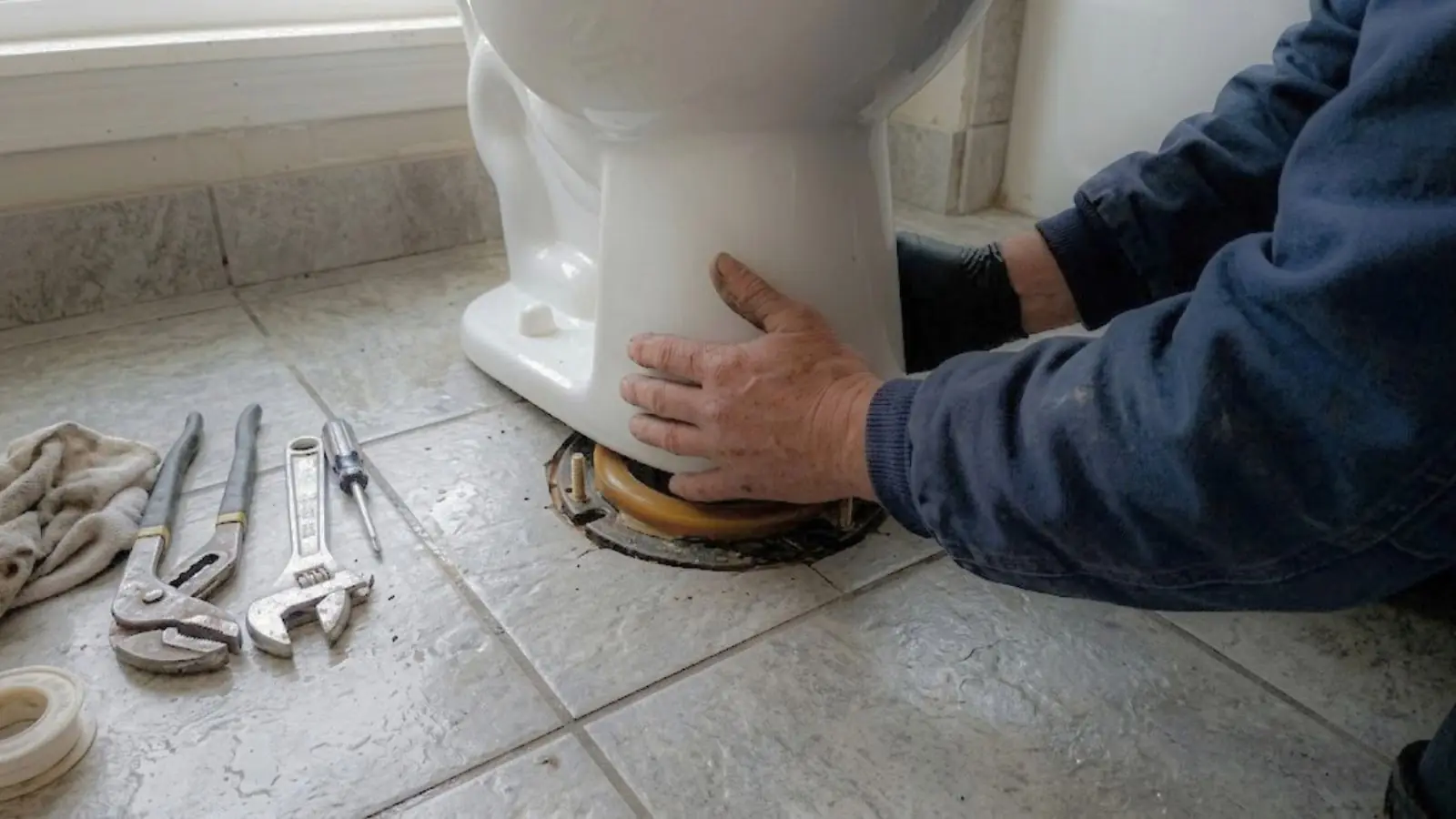
A wax ring seals the base of the toilet to the drain flange. When a toilet rocks or the flange is damaged, the seal breaks and water escapes each time you flush. Sometimes the first sign is a faint smell, a soft spot in the floor or a gap between the toilet and the floor.
Fixing it means turning off the water, draining the tank and bowl, lifting the toilet, replacing the ring and inspecting the flange. A flange that is cracked, corroded or sitting below the finished floor needs repair as well. This is also where we check the subfloor for soft wood.
Signs the leak has already damaged the floor
- The floor near the toilet feels soft or springy.
- Vinyl or tile has lifted or discolored.
- A musty smell remains after the area is dry.
- The ceiling below the bathroom has a stain.
When to call a plumber
Call if water is coming from the floor seal, if the shutoff will not close, if the floor feels soft or if you are not sure where the water starts. A leak you cannot find might be a hidden line, so ask about leak detection. We answer 24/7 and offer same-day appointments when available.
If you live in the valley, our dispatch also covers Fillmore and Ventura.
Why a small toilet leak gets expensive
A leak at the base does not stay at the base. Water wicks into the subfloor, loosens tile adhesive, swells baseboards and can stain the ceiling below. By the time any of that shows, the wood may be soft, and the repair is no longer a wax ring. That is why a faint, recurring dampness is worth chasing right away.
A running toilet is a different kind of waste. It can send water down the drain all day with no puddle to warn you. Check your meter with every fixture off. If the dial moves, something is leaking, and a toilet is the first place to look.
Repair or replace the toilet
Most leaks are cheap parts. A cracked tank or bowl is different. A hairline crack in porcelain cannot be sealed for good, and it can open further without warning. If the crack is in the tank or the bowl, replacement is the right call.
Replacement also makes sense when a toilet is decades old, has needed several repairs or flushes poorly. A new toilet sits on a new wax ring and gives you a chance to check the flange and the floor while it is out.
A five minute check twice a year
- Press on the side of the tank and the bowl and look for movement or wetness.
- Rock the toilet gently to see if it shifts on the floor.
- Look at the supply line and the shutoff for crust or drips.
- Check the floor around the base for soft spots or discoloration.
- Flush and listen for the tank to refill and stop.
Catching a loose base early saves the floor. Tightening the closet bolts a little at a time, without cracking the porcelain, sometimes restores a seal that is only slightly loose.
Toilet leaks in Santa Paula homes
Older Santa Paula homes, especially the bungalows, Victorians and craftsman houses around the historic downtown on Main Street, often have older floors and older flanges. Wood subfloors in homes of that age can be damaged by a slow leak that was never noticed.
Ask your water utility how to read your meter. With every fixture off, a moving meter dial tells you whether a hidden leak or a running toilet is using water. If you plan a remodel, ask the City of Santa Paula building department whether permits apply to fixture changes.
Frequently asked questions
Dry everything, lay toilet paper around the base and flush. Water at the base after a flush points to the wax ring or flange. Water dripping from under the tank points to the bolts or the gasket.
Caulk hides the symptom and can trap water under the toilet. Leaks at the base need a new seal.
No. A running toilet is water leaking from the tank into the bowl and does not show on the floor.
Check the floor for soft spots and the flange for cracks, because older homes near downtown often have older floor framing.
Often under a couple of hours if the flange and the floor are sound. Rot or a damaged flange adds work.
Toilet leak you cannot find or fix? Our line is answered 24/7.
Call (805) 249-7135