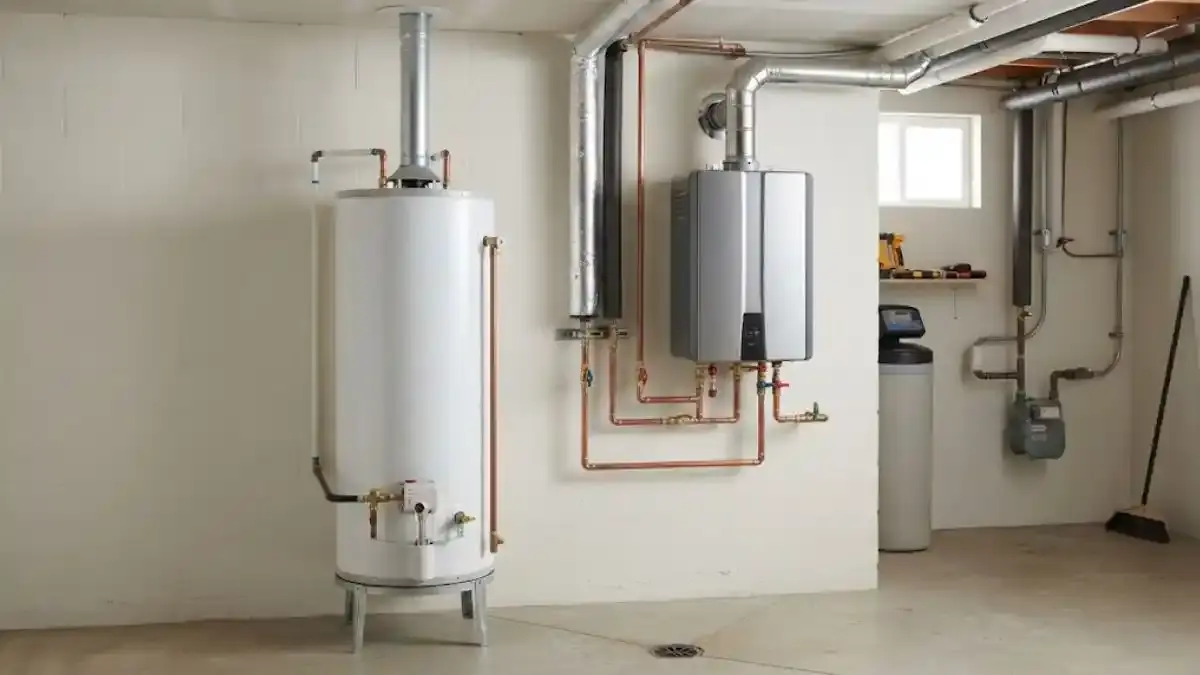
A 50 gallon tank is the most common size in family homes. When it fails, tankless is the obvious question, because it promises endless hot water in a smaller box on the wall. The promise is real, but the switch changes how your house gets gas, air and sometimes electricity.
This guide walks through what changes, what stays the same and when a new tank is the simpler choice. It does not quote prices, since the cost depends on your venting, gas line and the unit itself. We give a clear price before work starts once we see the site.
If your tank is leaking now, shut off power or gas and the cold valve and call us. The planning can wait for hot water to be back.
How tankless differs from a 50 gallon tank
A tank keeps about fifty gallons hot all day, which costs energy to maintain but delivers a lot of hot water at once. A tankless unit heats water only when a tap opens. It never runs out as long as demand stays within its flow rating, but it can struggle when several fixtures run together.
| Question | 50 gallon tank | Tankless |
|---|---|---|
| Hot water supply | Limited by tank size, then recovery time | Continuous within the flow rating. |
| Space | Floor space and clearance | Compact, wall mounted. |
| Gas line | Usually the existing line | Often needs a larger line. |
| Venting | Standard flue | Special vent material and routing. |
| Maintenance | Flush and anode checks | Descaling flushes on a schedule. |
Step one: size by flow, not by gallons
Add up the fixtures that may run at once. A shower, a dishwasher and a running kitchen tap are a common combination. Each has a flow rate, and the unit must deliver that flow at your desired temperature rise. The temperature of the incoming water matters, so ask your plumber how it affects the sizing.
A larger household may want a bigger unit or two units. A single person may need very little. See our tankless water heater page for the details.
Step two: check gas and electrical capacity
Gas tankless units draw a lot of gas for a short time. The existing line sized for a tank may be too small. Electric units draw a lot of power and may need new circuits, so ask an electrician whether your panel has room. Ask us about both before you buy.
Step three: plan the vent
Tankless units use specific vent materials and routes through the wall or roof, and some need a condensate drain. The tank you remove used a different flue. Moving a vent adds time and cost, so plan this early.
Step four: consider water quality
Scale builds on the heat exchanger of a tankless unit just as it does on a tank. If your water is hard, descaling flushes and sometimes a softener matter. Test your tap and see water softener and filtration.
When a new tank is the simpler choice
- The gas line or the panel would need major work.
- The vent cannot be routed without opening finished walls.
- Hot water use is light and steady.
- You need the lowest possible upfront cost.
A new tank is a legitimate choice. See water heater replacement for what that looks like.
What the installation involves
We shut off water and fuel, remove the tank, mount the unit, run vent and gas or power, connect water with isolation valves for flushing and test. Permit rules vary, so ask the City of Santa Paula building department what applies. See water heater installation.
Maintenance and descaling
A tankless unit needs periodic flushing to remove scale from the heat exchanger. The schedule depends on your water and the manufacturer. Isolation valves installed at the start make flushing easy, and skipping them makes the job harder.
Check the manual for filter cleaning and inspect the vent. A unit that is cared for lasts longer, and one that is ignored may show error codes or lose output.
The wait for hot water
Tankless does not make hot water arrive at the faucet faster. The water still has to travel through the pipe from the unit. Some homes add a recirculation loop or a small buffer tank. If long waits bother you now, ask about that option, because tankless alone does not solve it.
Questions to ask for a quote
- What flow rate and temperature rise is the unit sized for?
- Does the gas line, the vent or the panel need changes?
- Are isolation valves and a condensate drain included?
- Who handles permits and inspections?
- What does the warranty cover and for how long?
We give a clear price before work starts, after we look at the gas, the vent path and the room.
The bottom line
Tankless can be a good fit for a household that wants steady hot water and has the gas, vent and space to support it. A new tank is often the better value where those pieces would need major work. We look at your house and give you a clear price before work starts.
Tankless in Santa Paula homes
Santa Paula has a mix of older homes and newer builds, and the old and new differ in how easy it is to run a vent or upsize a gas line. A garage heater is usually easier to convert than one in a hallway closet.
Ask your water utility for its water quality report, and your gas utility whether your meter supports a larger appliance. We also help homes in Fillmore and Ojai, where older homes can have similar constraints.
Frequently asked questions
It depends on your household, your gas line, your venting and your budget. Neither is better in every house.
It delivers hot water continuously within its flow rating, but running too many fixtures at once can exceed it.
Often yes. Gas units draw more gas at once than a tank, so we check the line first.
By the flow of the fixtures that may run together and the temperature rise needed.
A garage often has the room and wall access for a vent and a larger gas line, which can make the swap simpler than in a closet.
Want to talk through tank or tankless? Call our line any hour.
Call (805) 249-7135